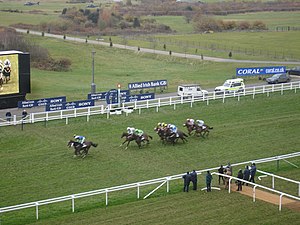
Ascot Racecourse is a famous English racecourse, located in the small town of Ascot, Berkshire, used for thoroughbred horse racing. It is one of the leading racecourses in the United Kingdom, hosting 9 of the UK's 32 annual Group 1 races, the same number as Newmarket. The course is closely associated with the British Royal Family, being approximately six miles from Windsor Castle, and owned by the Crown Estate.
Ascot today stages twenty-five days of racing over the course of the year, comprising sixteen Flat meetings held in the months of May and October. The Royal Meeting, held in June, remains a major draw, the highlight being the Ascot Gold Cup. The most prestigious race is the King George VI and Queen Elizabeth Stakes run over the course in July.
History
Ascot Racecourse was founded in 1711 by Queen Anne. The first race, "Her Majesty's Plate," with a purse of 100 guineas, was held on 11 August 1711. Seven horses competed, each carrying a weight of 12 stones (76 kg). This first race comprised three separate four-mile (6437 m) heats.
In 1813, Parliament passed an act to ensure that the grounds would remain a public racecourse. In 1913, Parliament passed an act creating the Ascot Authority, an entity that manages the racecourse to this day. From its creation until 1945, the only racing that took place at Ascot was the Royal Meeting, a four-day event. Since that date, more fixtures have been introduced to the grounds, notably the Steeplechase and hurdles in 1965.
Ascot racecourse closed for a period of twenty months on 26 September 2004, for a £185 million redevelopment funded by Allied Irish Bank and designed by Populous and Buro Happold. As owner of the Ascot estate, Her Majesty Queen Elizabeth reopened the racecourse on Tuesday 20 June 2006.
However upon re-opening, the new
grandstand has attracted widespread criticism for failing to provide sufficient raised viewing for patrons to watch the racing, and devoting too much space to money-spinning restaurants and corporate hospitality facilities.At the end of 2006 a £10 million programme of further alterations was announced to improve the viewing from lower levels of the grandstand using an innovative steel composite product ("SPS" Sandwich plate system) to reprofile the existing concrete terraces. However, the upper levels provide far less accommodation for the everyday racegoer than was present in the former stand.
In March 2009 it was confirmed that the main sponsors of Ascot, William Hill would be ceasing their sponsorship deal, citing that the decision by the BBC to reduce live race coverage as the main reason in its decision making process.In July 2009, Ascot Racecourse also hosted the third round of the UAE President's Cup.
The centrepiece of Ascot’s year,
Royal Ascot is one of the world’s most famous race meetings, and dates back to 1711. The Queen attends the meeting, arriving each day in a horse-drawn carriage. It is a major event in the British social calendar, and press coverage of the attendees and what they are wearing often exceeds coverage of the actual racing. The Royal Enclosure has a strict dress code—male attendees must wear full morning dress including a top hat, whilst ladies must not show bare midriffs or shoulders and must wear hats. Outside the Royal Enclosure the dress code is less severe, but many people choose to wear formal dress anyway. To be admitted to the Royal Enclosure for the first time one must either be a guest of a member or be sponsored for membership by a member who has attended at least four times. This continues to maintain a socially exclusive character to the Enclosure. Over 300,000 people make the annual visit to Berkshire during
Royal Ascot week, making this Europe’s best-attended race meeting. This leads to a split among racing fans, some of whom are glad to see racing in the spotlight, and getting more attention, while others do not like the meeting despite the quality of racing.
There are 16 Group races on offer, with at least one Group One event on each of the five days. The Ascot Gold Cup is on Ladies' Day on the Thursday. There is over £3,000,000 of prize money on offer.